
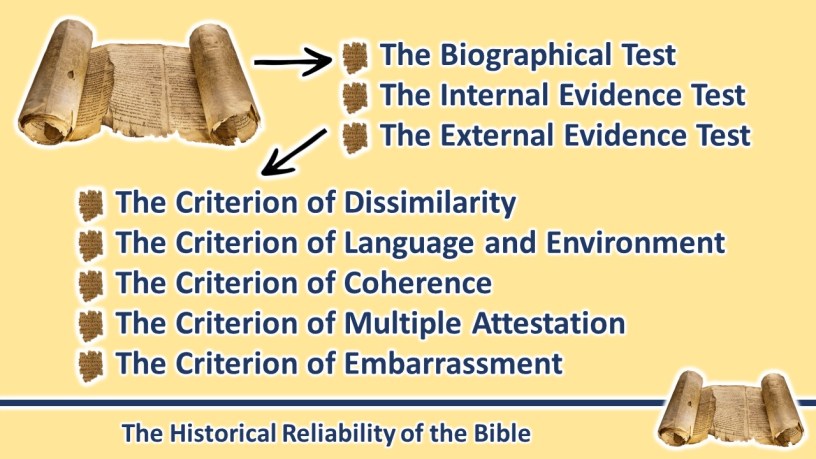
Did you know that there are certain factors, certain standards that historians and archaeologists use to measure the historical reliability of an ancient document? Things like verifying an authenticated copy of an original document (called a “manuscript”), how many copies or manuscripts there are, how closely those copies date to the original composition, and how similar the various manuscripts or copies are to each other (their internal consistency with each other).
Scholars apply a series of tests to ancient documents to evaluate their authenticity as historically reliable.
One is the Biographical Test, which asks how close (in time) our present copies date from the original composition. Why do we rely on manuscripts or copies of an ancient document? Because the originals rarely survive over time due to deterioration or destruction.
Second is the Internal Evidence Test, which asks if the original writer was a first-hand eye-witness to what happened, or are they just someone who got the information second-, third-, or fourth-hand from the original eye-witness?
Third is the External Evidence Test, which asks what collaborating evidence exists to support the credibility of the document? Such as archeological finds, scientific discoveries, and other trusted historical documents and artifacts to corroborate the testimony of the document in question.
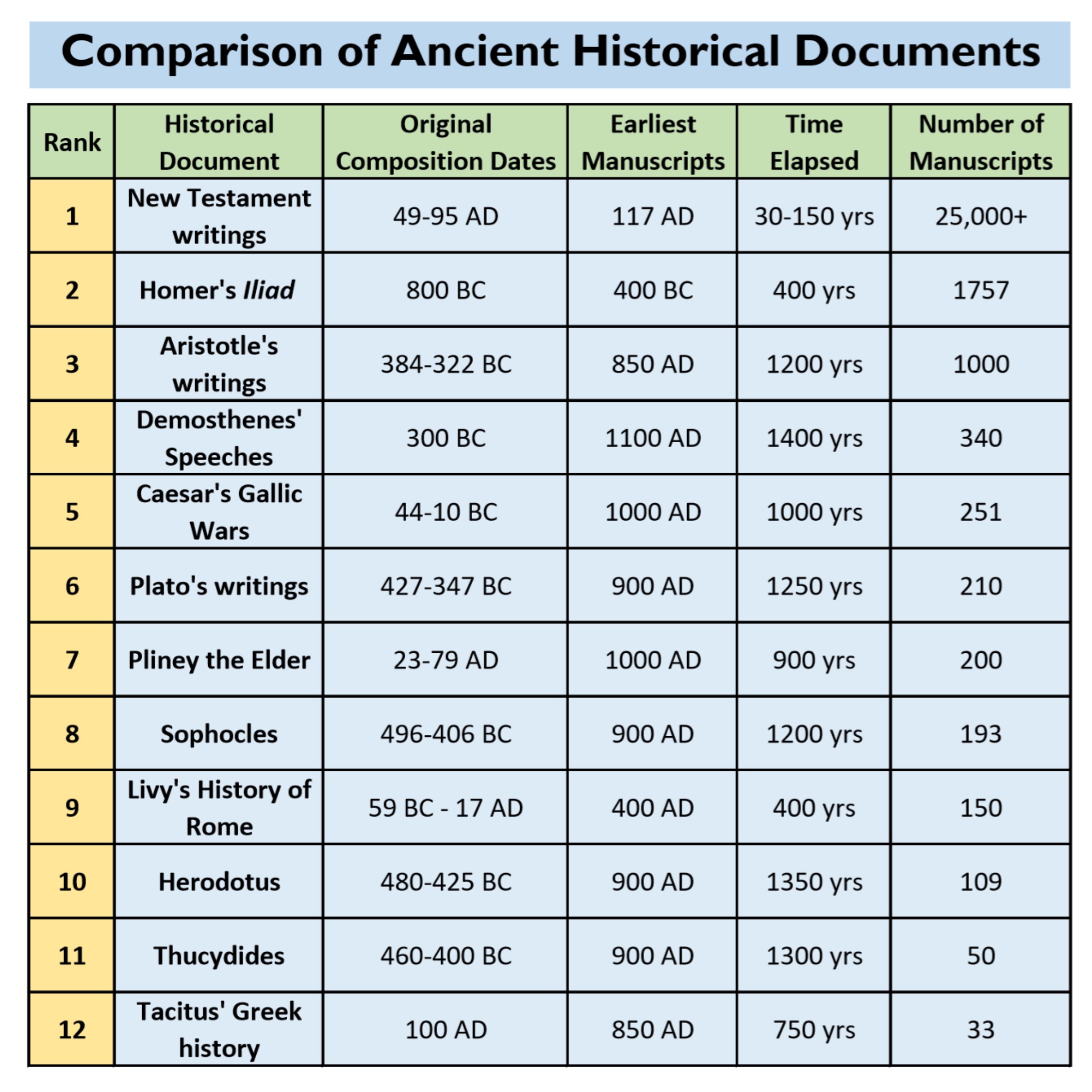
For instance, the fifth most reliable document from ancient times is Caesar’s Gallic Wars. These documents were originally composed between the years of 44-10 BC. The earliest manuscripts (authenticated copies) of the original composition that we have are from about 1000 AD. That means the closest copies of the original we have are about 1000 years removed from the original writings. And we have about 250 such manuscripts/copies.
Now, these writings are not in dispute. Their historical accuracy is accepted within the scientific and anthropological communities. Their accounts of the Gallic Wars are accepted as factual, and they are printed in textbooks as historically accurate. Remember, that’s information we have based on 251 copies which date from more than 1000 years from the original composition. Are you with me?
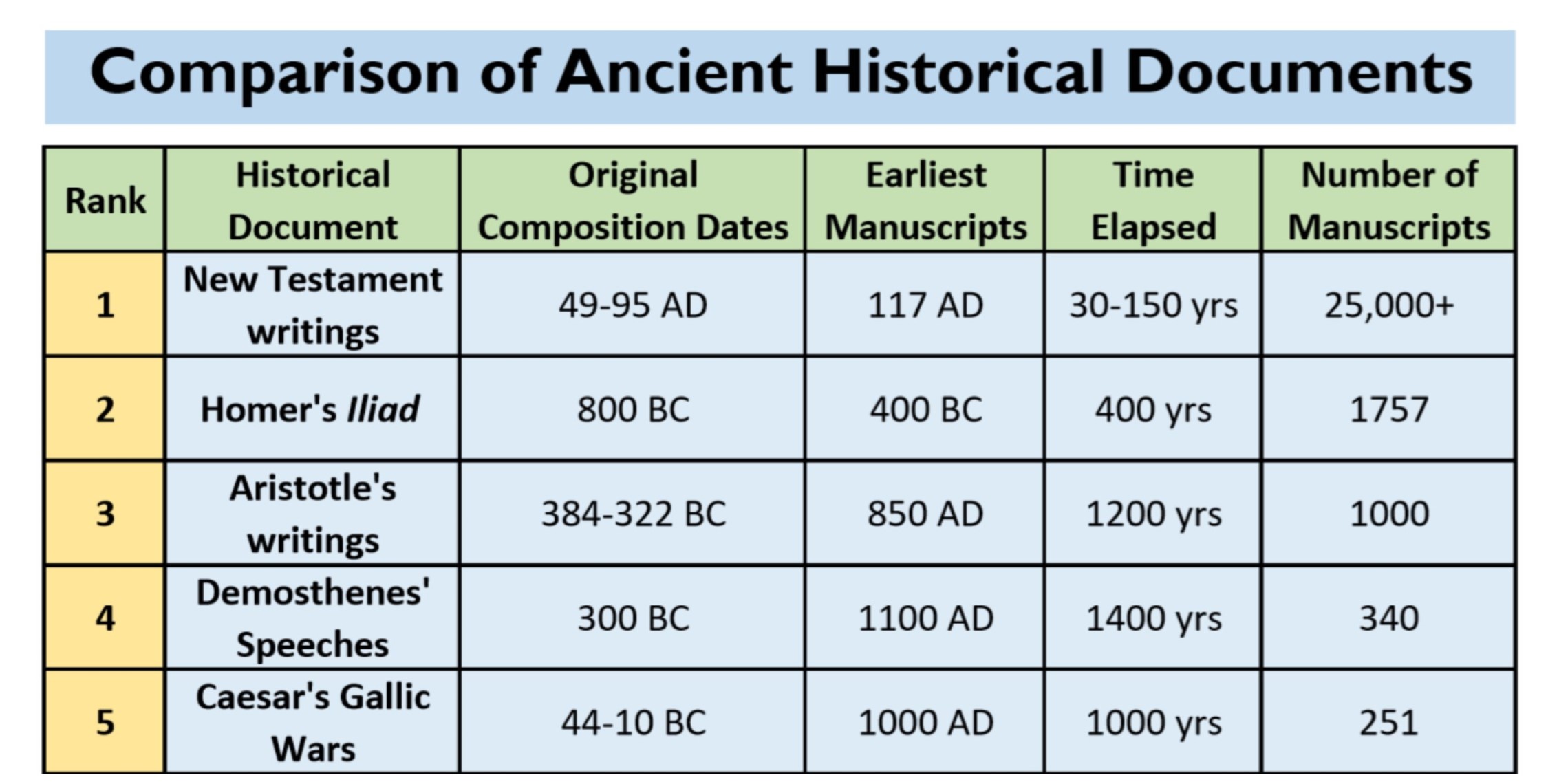
The fourth most historically reliable documents we have from ancient times are Demosthenes’ Speeches, which date from 300 BC. The earliest known manuscripts are from 1100 AD – that’s 1400 years after the original composition! And we have about 340 such copies.
In third place is Aristotle’s writings, from the 4th-Century BC. We have about 1000 manuscripts of these writings dating from 850 AD, which is about 1200 years from the originals.
The second-most historically reliable documents from ancient times come from Homer’s Iliad, which were composed in 800 BC, and whose earliest manuscripts date from just 400 years later. This puts it well in front of the others in the Top 5, as does its number of manuscripts, which is 1757!
All of these – the writings of Demosthenes, Aristotle, Homer (and more below) – they are all accepted as historically accurate and factual by secular culture. No question, no doubt, total acceptance.
But none of these compare – none come anywhere close to – the objective, scientific, historical verifiability of the writings of the Biblical New Testament. The Books of the New Testament (NT) were all composed between the years of 49-95 AD, and the earliest manuscripts we have of the original NT compositions date from 30 years – 30 years(!) after the original writings! That means we still have copies of the original NT writings that date from within the lifetimes of the original authors themselves! No other documents from ancient times come anywhere close to that!
The other factor is the sheer number of authenticated manuscripts we have, which has eclipsed 25,000 in the last decade, thanks to ongoing archaeological findings. 25,000! Which date from within 30 years of the original compositions. This is many times more than the second-most historically reliable documents we have, and exponentially more than the others in the Top 10!
Sheri Bell, in her article on “Testing the Historical Reliability of the New Testament” explains it this way:
“That equates to one mile of New Testament manuscripts (and 2.5 miles for the entire Bible), compared with an average four feet of manuscript by the average classical writer.”
The Bible writings, and specifically those of the New Testament – all about Jesus’ life, teachings, death, resurrection, ascension, and the works, travels, and teachings of his immediate followers – are by far, by many times over, the most historically reliable documents humanity has from ancient times. When you read the Bible, you are reading a religious work for sure – but you are also reading an objectively, scholarly, and scientifically-authenticated work from and about history.
The writings of the New Testament are not merely “stories” – they are accounts – eyewitness testimonies of actual events that really happened – historically verified and cross-authenticated by science, archaeology, and anthropology.
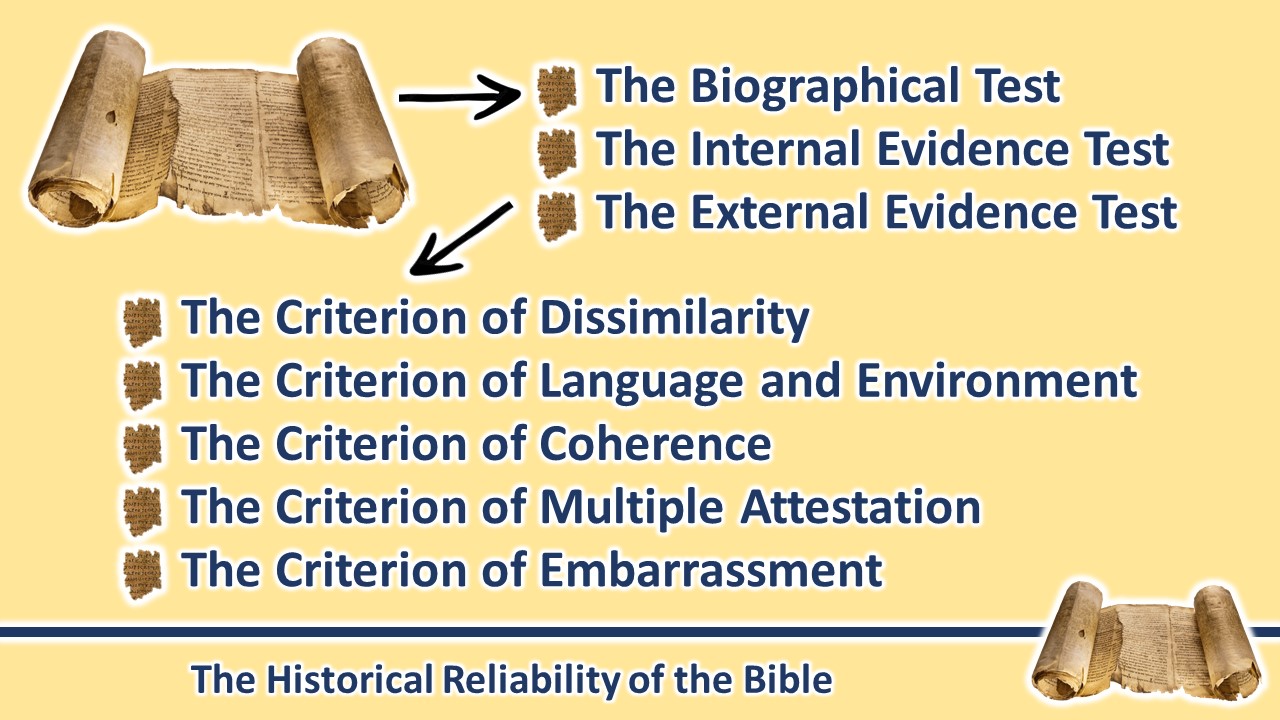
Now, there are five criteria used by scholars to measure the authenticity of an ancient text:
- Criterion of Dissimilarity
- Criterion of Language and Environment
- Criterion of Coherence
- Criterion of Multiple Attestation
- Criterion of Embarrassment
We don’t have nearly enough time to delve into all of these, but the Bible passes all of them with flying colors. What’s important to note is that these are all compounding criteria. They are not simply a 5-part checklist like the addition of 1+1+1+1+1=5. They are more like factorials that multiply exponentially as an ancient document “passes” each criterion.
So an ancient text that passes Criterion #2 is not just 1 more criterion better than before, it is many times more trustworthy. An ancient text that passes Criterion #3 is not just 1 more than Criterion #2, but many times more. So that by the time you get to Criterion #3 and 4, the ancient text is exponentially more reliable than one that only makes it just one criterion less.
A document that passes 4 out of 5 is exponentially more reliable than a 3 out of 5. And a 5 of 5 is exponentially more reliable than a 4 of 5. The writings of the Bible are a 5 out of 5 for the scholarly authenticity required of ancient texts.
And all of that is only after an ancient text has already passed the Biographical Test, the Internal Evidence Test, and the External Evidence Test! It doesn’t even qualify to be scrutinized under the five compounding scholarly criteria for authenticity until it first passes those first three tests. So you can see just how much scholarly and scientific examination the Bible has passed through to achieve its status as historically reliable and trustworthy.
I do want to highlight the Criterion of Embarrassment. It is the fifth criterion, which means scholars don’t even apply it unless a document successfully passes the first four criteria. But if an ancient text passes the criteria of Dissimilarity, Language and Environment, Coherence, and Multiple Attestation, then the Criterion of Embarrassment is applied, and this is what it says: the measure of authenticity for an historical account increases under the inference that the author would have no reason to invent an historical account which might embarrass them.
• For Christianity, the crucifixion (at the time) was the most shameful and humiliating way for a person to die. It was the Romans’ favorite way to make an example of political dissidents, essentially saying, “You do not want to be like this person or follow his example.”
• Peter’s denial of Jesus three times, whom Jesus would later put in charge of the Church
• David, Israel’s greatest king and “a man after God’s own heart,” committed adultery and murder
• Moses killed an Egyptian in cold blood
• Abraham lied about his wife Sarah when they entered Canaan because he feared Abimelech would kill him to take her
• Jonah pitched a temper tantrum when God forgave the Ninevites who repented of their sin
• One of Jesus’ 12 disciples betrayed Him and committed suicide, and 11 ran and hid in terror for their lives after Jesus was crucified!
If you were starting a new religion based around a person you really liked and wanted to convince other people to follow, you wouldn’t fill your accounts of His movement with all of the failures and embarrassments of His earliest followers! Especially not in a shame-and-honor culture like those in the Ancient Near East. “Our leader was executed by Roman crucifixion and all His earliest followers deserted Him” is a terrible way to convince people to join your movement. The Biblical writers had no incentive to make up the accounts they wrote and shared with the world.
By the way, no other sacred text in the entire catalogue of world religions passes the Biographical Test, the Internal Evidence Test, the External Evidence Test, and the five compounding scholarly criteria for the authenticity of an ancient text like the Bible. Not even close. None of the others even ranks anywhere near the Top 12 of all ancient texts!
So why am I telling you all of this?
I mean, it’s cool to learn all the scholarly and scientific bases for understanding the historical validity of something!
But more important than just the trivia or information of it, I want us all as followers of Jesus to have confidence in the Bible – not just as a good book, or a book of wise teachings and advice, not just as a collection of interesting stories – but as an historically-accurate and fundamentally true and reliable document – inspired by God, recorded by His followers, preserved and passed down through the generations with the utmost integrity, reliability, and verifiability.
We do not have to just blindly accept the truth of the Bible by faith. And we are not just taking somebody’s word for it, and trusting that they’re not lying to us about it.
No other ancient text in all of human history has received the scrutiny and examination that the Bible has. No other ancient text compares to the Bible in terms of its internal integrity, its external scrutiny, and its criteria for scholarly authenticity. No other document from ancient times has nearly as many as trustworthy and verified copies of the original, dating so close to the original and having as high of a percentage of agreement among them all as the Bible has!
Frankly – and this is just me – but I think it takes far more faith to believe that the Bible is a fabrication than it does to believe that the Bible is accurate.
So that when we build our lives upon the teachings and examples found in the Bible, we can do so with confidence: confidence in God who inspired it, and confidence in the process that carried it from the moment of its recording thousands of years ago to being a printed, bound book in our languages and in our hands today.
I’ll finish with this quote from Biblical scholar Dr. Carey Vinzant:
“If history tells us that Jesus existed (which it does), if the New Testament manuscripts that tell us about Him are of outstanding quality and integrity (which they are), and if the people who knew Him best were convinced that He both claimed to be and was the Son of God (which they were), then we have to take seriously the plausibility that the Biblical account of Jesus is the true one.”
Sources:
Sheri Bell, Josh McDowell Ministry, “Testing the Historical Reliability of the New Testament.” Posted on January 10, 2018. Accessed online at https://www.josh.org/historical-reliability-new-testament/.
Teri Dugan, TruthFaithAndReason.com, “Case-Making 101: How does the Bible compare to other ancient documents?” Posted on December 4, 2016. Accessed online at https://truthfaithandreason.com/case-making-101-how-does-the-bible-compare-to-other-ancient-documents/.
Evidences for Christianity, “4.1 Manuscript Evidence for the New Testament”. Accessed online at http://www.evidencesforchristianity.org/manuscript-evidence.html.
Clay Jones, “The Bibliographical Test Updated” Christian Research Journal, volume 35, number 03 (2012). Accessed online at https://www.equip.org/articles/the-bibliographical-test-updated/.
Sir Frederick Kenyon, Bible and Archaeology (Harper & Bros, 1940).
Frederic G. Kenyon, Our Bible And The Ancient Manuscripts: Being A History Of The Text And Its Translations (Kessinger, 2007).
Bruce M. Metzger and Bart D. Ehrman, The Text of the New Testament: Its Transmission, Corruption, and Restoration (Oxford UP, 2005).
J. Warner Wallace, Cold-Case Christianity: A Homicide Detective Investigates the Claims of the Gospels (David C. Cook, 2013).
 Like Trees Planted