
Grief is not linear: it doesn’t move nicely from step 1 to step 2 to step 3 and so on. Grief is unpredictable; it comes, then goes… swells then recedes… it surprises us at unexpected moments.
Grief hurts. And so in self-defense, we seek to avoid it. We run from it, ignore it, pretend we don’t need it, or that is doesn’t bother us. We hide from it – in humor or silence or busyness. These coping mechanisms are normal, but they never actually satisfy or solve grief. After we’ve tried all these tactics, it’s still there. There is only one thing we can do with grief, and that is to experience it.
We hope it will just go away, leave us alone, and forget about us. But grief is inevitable. There is no way around it. We can’t pass over it. We can’t tunnel under it. The only way to the other side of grief is through it.
The good news is that the slog through grief needn’t be traveled alone. It is a journey we can (and should!) take with others. Others who love us and care about us and understand what we are going through.
That’s all fine, but – how? How do I grieve with others? And how does this get us “through” it?
Emotional pain is a unique human experience. When we share it with one another, it divides and disperses amongst us. The potency of pain is diluted in the act of sharing it with others.
We share it with others by telling a small handful of trustworthy people what we are feeling, by naming those feelings – whether they be anger, sadness, disbelief, fear, anxiety, loneliness, regret, remorse – we identify and name those emotions, and describe them for 1 or 2 or 3 people in our lives who love us and have our back.

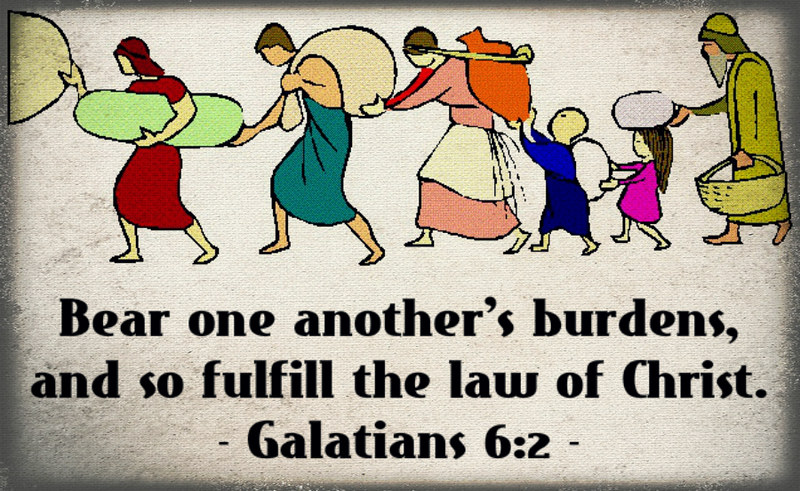
Galatians 6:2 says, “Bear one another’s burdens and so fulfill the law of Christ.” What is “the law of Christ?” In Matthew 12, one of the experts in the religious law was trying to trick Jesus into saying something illegal or blasphemous so He could be discredited or even arrested. The lawyer asked Jesus, “Which of God’s laws is most important?” And Jesus replied, “Love the Lord your God with all your heart, soul, mind, and strength, and love your neighbor as yourself. There is no law greater than these.”
When we bear one another’s burdens – when we divide and dilute and disperse our pain together with others we trust who love us, the most important laws of God are being fulfilled!
So we identify, name, and share our grieving emotions with those around us. We also share memories, telling the stories of those we’ve lost with others who knew them. These informal eulogies (literally “good words” from the Greek) memorialize the loved one who has gone, and strengthens our bond with them, galvanizing our connection, and so helping to dispel the pain of grief.
And lastly, we remind ourselves and each other that God loves people more than anything else (Jeremiah 33:3). That He takes no pleasure in the death of anyone (Ezekiel 18:32). That He cares deeply when His loved ones die (Psalm116:15). And that He weeps with us in our pain (Isaiah 63:9 and John 11:35).
The journey of grief is agonizing and unavoidable. All attempts to run from it or numb it away fail, and sometimes those actions make the situation worse. The only effective thing we can do with grief is experience it, and the only way to the other side of grief is through it.
The healthiest way to experience it and pass through it is with the companionship of others and with our trust holding tight in the loving Presence of our understanding God.
 Like Trees Planted
Nick, this is very well said and important to live out in the context of community. Thank you!