

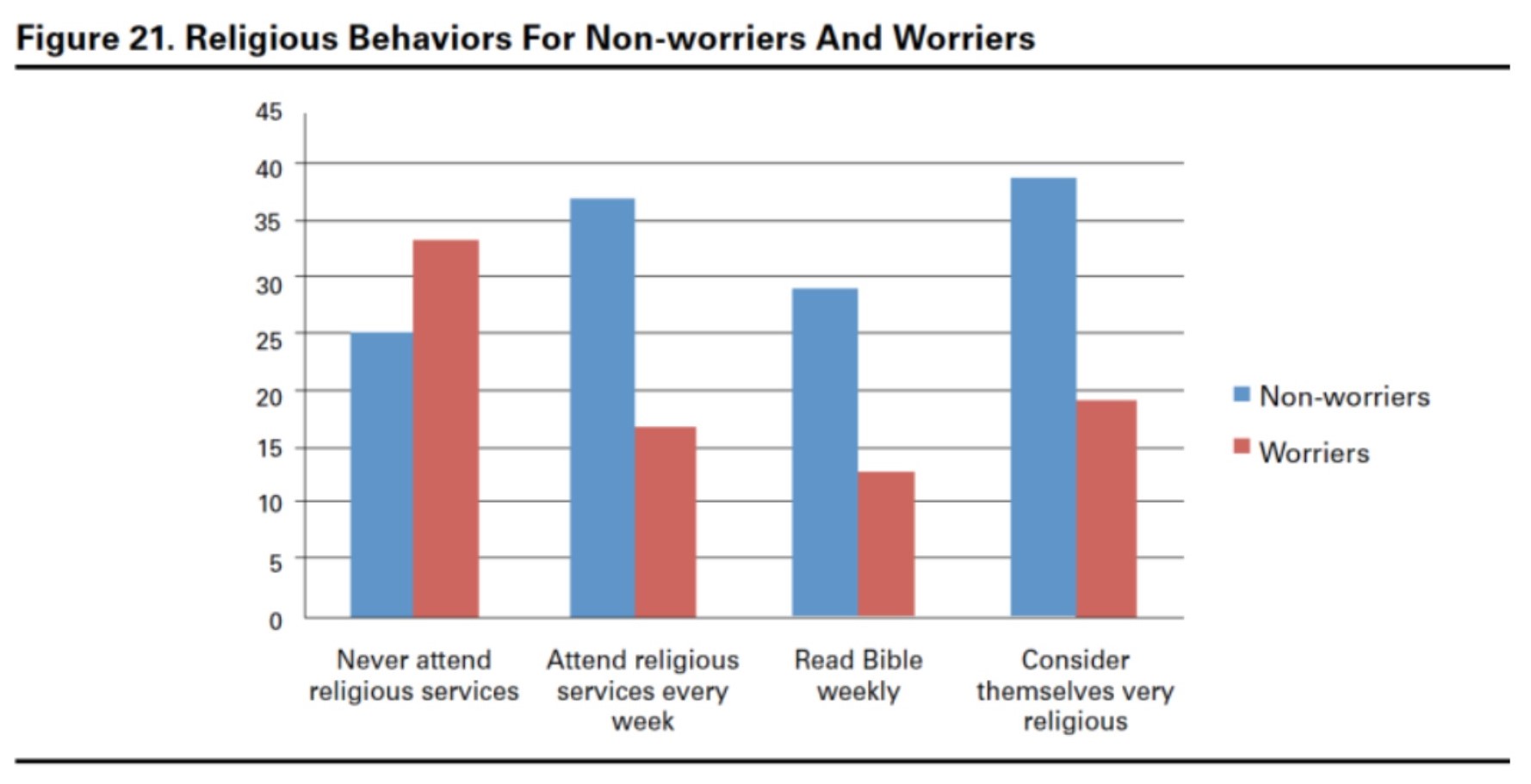
Did you know that people who participate in church are less than half as likely to struggle with anxiety as those who don’t?
Or that people who read the Bible regularly report worrying less than half as often as those who don’t?
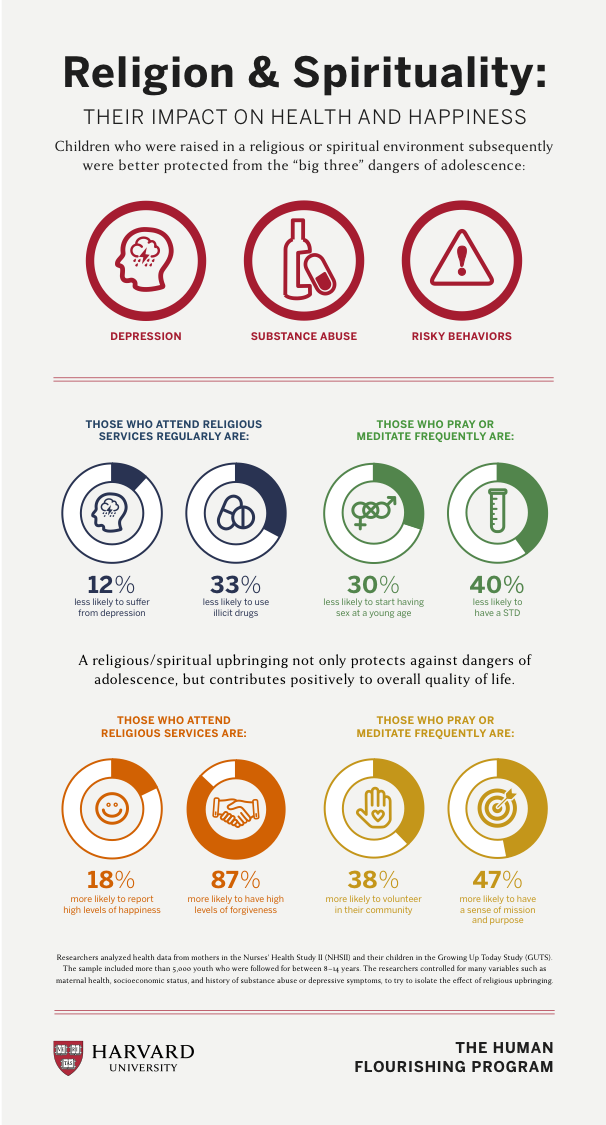
Or that those who pray or meditate frequently are 47% more likely to have a sense of mission and purpose than those who don’t?
Regular participation in religious activities has widespread benefits on a whole range of human flourishing!
According to extensive statistical research from The Pew Research Center and Harvard University, involvement in religious activities “provides a wide range of significant benefits at both the individual and societal level.” 1
“Higher religious involvement is related to lower divorce rates, higher marital satisfaction, and better child adjustment.” 2
“At the individual level, many studies have shown that religion is linked to various measures of physical health, such as lower rates of coronary disease, emphysema and cirrhosis, lower blood pressure, and longer life expectancy.” 3 4
“Finally, there is ample evidence that religion is positively related to higher levels of subjective well-being. Statistical data from a national sample shows that those who are most involved with their religion are almost twice as likely to report being ‘very happy’ than those with the least involvement, while religious variables account for 5-7% of variance in [overall] higher life satisfaction.” 5
The report goes on to conclude “it is likely that a number of factors underlie the link between religiosity and well-being, from the social support and pro-social behaviors that religion encourages, to the coherent framework that religion provides, to the coping mechanisms that alleviate stress and assuage loss. One recent investigation traced the benefits of religious involvement to the cumulative effect of the positive boosts in well-being that people receive each time they attend religious services.” 6
The good news is that religious activities and their extensive benefits are open to everyone! You don’t have to be a person of faith to attend church, read the Bible, or pray. Jesus welcomes those with doubts, promising to meet them at their place of disbelief – if they will only come to Him with the willingness to move from distrust to trust. (See John 20:24-29)
If you have questions about how to do any of these things, or would like assistance in getting started, I would be delighted to teach you how to pray, read the Bible, or get the most out of church participation. Email me anytime at nick@liketreesplanted.com.
Sources:
Harvard University – The Human Flourishing Program. Accessed online at https://hfh.fas.harvard.edu/religious-communities on January 8, 2024.
Church4EveryChild – Relationship between anxiety and church attendance. Accessed online at https://church4everychild.org/2014/08/07/the-relationship-between-anxiety-and-church-attendance/ on January 8, 2024.
1 The Benefits of Religion – chrome-extension://efaidnbmnnnibpcajpcglclefindmkaj/https://www.hbs.edu/ris/Publication%20Files/mochon%20norton%20ariely%20who%20benefits%20from%20religion_e072e4b1-8c04-4698-9cdf-e2d27b1f237d.pdf
2 Mahoney, A., Pargament, K. I., Tarakeshwar, N., & Swank, A. B. (2001). Religion in the home in the 1980s and 1990s: A meta-analytic review and conceptual analysis of links between religion, marriage, and parenting. Journal of Family Psychology, 15(4), 559–596.
3 George, L. K., Ellison, C. G., & Larson, D. B. (2002). Explaining the relationship between religious involvements and health. Psychological Inquiry, 13(3), 190–200.
4 Litwin, H. (2007). What really matters in the social network-mortality association? A multi-variate examination among older Jewish-Israelis. European Journal of Ageing, 4, 71–82.
5 Mochon, D., Norton, M. I., & Ariely, D. (2008). Getting off the hedonic treadmill, one step at a time: The impact of regular religious practice and exercise on well-being. Journal of Economic Psychology, 29(5), 632–642.
6 Ibid.
 Like Trees Planted